Be INFORMED

Friday, October 07, 2011

Occupy Wall Street Highlights Tea Party's Bogus Populism

Avenging Angel   Wed Oct 05, 2011

Back in April 2009, Daily Show host Jon Stewart summed up the Tea Party movement, "I think you might be confusing tyranny with losing."  His description, it turns out, was exactly right.  Tea Partiers complained they were "Taxed Enough Already" despite virtually all receiving tax relief from President Obama and America seeing the total federal tax burden at its lowest level since 1950.  They decried "Obamacare" for its nonexistent "death panels" and "government takeover of health care" even as the Affordable Care Act would cover 30 million more Americans and reduce the U.S. national debt.  And after pocketing millions of dollars in funding from the usual right-wing sugar daddies, the Tea Party's Republicans in Republicans' clothing duly voted Republican in the 2010 midterm elections.

Which is why the leading lights of the Republican Party are so quick to denounce the Occupy Wall Street movement now spreading across the country.  Its platform and ultimate political impact may not be clear.  But unlike the Tea Party, its populism is authentic.

That goes a long way towards explaining the vitriol coming from Republican candidates and their amen corner.  For his part, National Review editor Rich Lowry declared, "Occupy Wall Street is toxic and pathetic."  Michelle Malkin, who in 2009 urged her readers to "Go Galt" in response to Barack Obama giving them the largest two-year tax cut in modern American history, chortled that the OWS rallies around the country are 99% white.  And Herman Cain, the new GOP White House frontrunner of sorts, blamed the protesters themselves for their economic plight:

"I don't have facts to back this up, but I happen to believe that these demonstrations are planned and orchestrated to distract from the failed policies of the Obama administration. Don't blame Wall Street, don't blame the big banks, if you don't have a job and you're not rich, blame yourself! [...] It is not someone's fault if they succeeded, it is someone's fault if they failed."

Mitt Romney, the $250 million man who proclaimed himself "middle class" and joked with jobless voters that "I'm also unemployed," had another term for those demonstrating against the Wall Street banks that caused the national financial calamity they alone have recovered from.

"I think it's dangerous, this class warfare."

To that, a puzzled Donald Trump added, "Nobody knows why they're protesting."

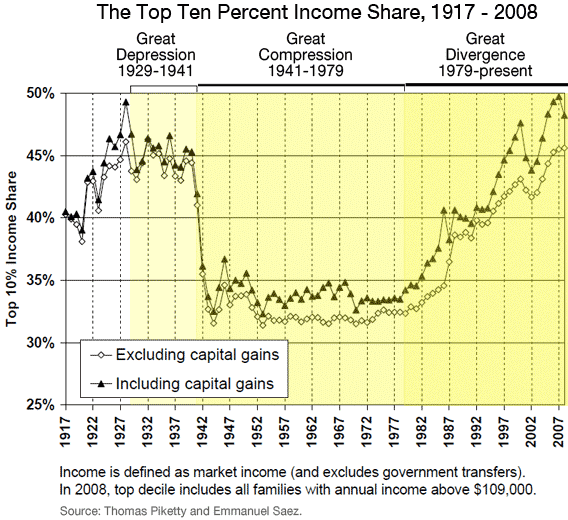
Here's a clue.  The 99%, as Ezra Klein described the protesters, "sense that the fundamental bargain of our economy -- work hard, play by the rules, get ahead -- has been broken, and they want to see it restored."  Personally struggling with stubbornly high unemployment and endless home foreclosures, they see corporate America back to record profitability after Wall Street banks were bailed out by American taxpayers.   While executive pay rose by 23% last year, since 2009 corporate profits "captured 88% of the growth in real national income while aggregate wages and salaries accounted for only slightly more than 1% of the growth in real national income."  At with income inequality at its highest level in 80 years and the federal tax bill at its lowest in 60, proposals for even small increases in upper income tax rates are greeted with charges of "class war" from those who won it.

Perhaps more than anything, the Washington Post's Suzy Khimm explained Tuesday, the Occupy movement wants "less corporate money in politics."  In contrast, as Politico documented just the day before, the Tea Party wants more:

The groups -- Americans for Prosperity, FreedomWorks, Club for Growth, Leadership Institute and Tea Party Express - raised $79 million last year. That's a 61 percent increase from their haul in 2009, when the tea party first started gaining traction, and an 88 percent increase over their tally in 2008, according to a POLITICO review of campaign reports and newly released tax filings.

And the two biggest groups -- Americans for Prosperity and FreedomWorks -- tell POLITICO they're planning to raise and spend a whopping $156 million combined this year and next, laying the groundwork for what could be a massive tea party organizing push against Democrats and the occasional moderate Republican in 2012.

From the beginning, those front groups for Dick Armey and the Koch brothers funded and coordinated the Astroturfed Tea Party movement, even distributing strategy memos on how to disrupt Democratic town hall meetings.

6215884986_c7bea4afc1

But largely lost in that seeming consensus about the triumph of right-wing populist anger in November was the inescapable truth about the Tea Partiers. That is, these older, whiter and more ideologically conservative voters are just Republicans by another name. And by the time the 2012 GOP presidential primaries roll around, they will be indistinguishable from the rest of the Republican hard line base.

To be sure, the 2010 exit polls confirmed that Tea Baggers are just Republicans who shout louder. The national House exit poll found that 40% of those surveyed supported the Tea Party. That's virtually identical to the 41% favorable opinion of the Republican Party. Unsurprisingly, their behavior in the voting booth was also identical, as the GOP captured 87% of the Tea Baggers' ballots.

If you had any lingering doubts that the Tea Party's righteous rage and town hall takeovers was just a continuation of the 2008 presidential campaign by others, just take a quick look back at any McCain-Palin rally from that fall.  Or, you can turn to the growing mountain of studies of showing that Tea Party Republicans are nothing new under the sun.

In August, professors Robert Putnam and David Campbell published their findings from a sampling of 3,000 Americans.  As their summed up what they learned about these ever more extreme - and unpopular - social conservatives:

Our analysis casts doubt on the Tea Party's 'origin story.' Early on, Tea Partiers were often described as nonpartisan political neophytes. Actually, the Tea Party's supporters today were highly partisan Republicans long before the Tea Party was born, and were more likely than others to have contacted government officials. In fact, past Republican affiliation is the single strongest predictor of Tea Party support today.

What's more, contrary to some accounts, the Tea Party is not a creature of the Great Recession. Many Americans have suffered in the last four years, but they are no more likely than anyone else to support the Tea Party. And while the public image of the Tea Party focuses on a desire to shrink government, concern over big government is hardly the only or even the most important predictor of Tea Party support among voters.

So what do Tea Partiers have in common? They are overwhelmingly white, but even compared to other white Republicans, they had a low regard for immigrants and blacks long before Barack Obama was president, and they still do.

Campbell and Putnam also exposed another aspect of the Tea Party ersatz populism.  "Next to being a Republican, the strongest predictor of being a Tea Party supporter today," they wrote, "was a desire to see religion play a prominent role in politics."

The Tea Party's generals may say their overriding concern is a smaller government, but not their rank and file, who are more concerned about putting God in government.

As for the tens of thousands of Occupy demonstrators in New York and around the country, they simply want corporations out of government.  And those nurses and students, unemployed technicians and supportive union members, want to see government to help put Americans back to work.

* Crossposted at Perrspectives *

Originally posted to Avenging Angel on Wed Oct 05, 2011 at 04:30 PM PDT.
Also republished by In Support of Labor and Unions, Class Warfare Newsletter: The Plutocracy VS the Working Class, Occupy Wall Street, and Community Spotlight.

Thursday, October 06, 2011

Occupy Wall Street Protesters…

…. are still going strong and there is a planned “ occupation “ today in Washington, D.C. Let us hope that there is a massive gathering of supporters at this event, and that at least one major mainstream news outlet is there to cover this with some real, actual reporting. That omits FoxNews by default.

    This is a movement which needs to gather more steam with each passing day not only in Manhattan and D.C., but in cities and towns all over the United States.

   Wake the hell up, people! The time is now to partake in some non-violent civil disobedience!

Jonathan Zimmerman, at The Christian Science Monitor:

Taking aim at corporate greed and corruption, the demonstrators embody a venerable tradition of American populism. From the dawn of the republic until the recent past, Americans celebrated hard-working folk and denounced financial titans who preyed upon them. However intemperate or excessive, their protest language fueled some of our most important social reforms – including the regulation and control of the financial sector itself.

Start with the author of the Declaration of Independence, Thomas Jefferson, who feared that a “moneyed aristocracy” would bind the young nation into a new set of chains. “And I sincerely believe...that banking establishments are more dangerous than standing armies,” Jefferson warned. He reserved special disdain for financial speculation, which he labeled “a species of gambling destructive of morality.”

Several decades later, Andrew Jackson denounced the Second Bank of the United States as essentially a scam to enrich the wealthy at the workingman’s expense. He also helped sweep away property requirements for voting and office holding, rendering every white male the political equal of the “stock-jobbers, brokers, and gamblers” he despised.

By the late 1800s, as massive financial corporations clustered in lower Manhattan, the populist animus found a new target: Wall Street. “A name more thoroughly detested is not to be found in the vocabulary of American politics,” thundered Georgia’s Tom Watson, vice-presidential nominee for the upstart “People’s Party” in 1896. “Here is Wall Street: we see the actual rulers of the Republic.... The Government itself lies prone in the dust with the iron heel of Wall Street upon its neck.”

      As a side note, today is also the 10th anniversary of the  U.S. Occupation of Afghanistan. A very good day for a protest!

Video Pirate: Stupid Person Of The Day

   I do not generally bother posting such things as “ Stupid Person of the Day “ or whatever, but I found something in my mailbox on Tuesday that made me think of just how stupid this person must be, so I’m sharing this with you.

   A piece of paper was placed into the mailbox apparently before the mail was delivered with a list of movies on it which are available for purchase. It even had a movies for children section with such titles as Cars 2, Rio, and the Smurfs. Of course, it contains the latest releases and even has a “ Newest “ section containing Abduction, Drive, and Killer Elite.

   What truly got me laughing was that this moron actually placed not just one, but two phone numbers at the bottom of the sheet!

  Come on now. Who in their right minds, selling something illegally, puts and ad in a mailbox with their phone numbers on it? How stupid can you be?

Dumb, Dumb, Dumb, Dumb


Wednesday, October 05, 2011

Medicare Open Enrollment…

    ….  time has come again for all of those Medicare recipients who wish to make changes with their coverage options for 2012. Enrollees even get an earlier start than previous years, with the current enrollment period to begin on October 15 and closing on December 7, which is also earlier than in the past.

   Those who wish to change plans can shop around right now as they hit the market on October 1. You can compare those plans at medicare.gov/find-a-plan or you can do it the old fashioned way by calling 1.800.MEDICARE.

   So, what about the cost this year? Medicare Advantage plans are expecting premiums to be 4% lower than last year, with the same level of coverage according to the Dept. of Health and Human Services.

   For original Medicare Part B, you will have to wait until later this fall to hear about any increases.

    Part D prescription-drug coverage premiums are expected to stay in the area of $30 a month, but there is a catch to this as generic drugs prices discounts are going up from 7% to 14% once you reach the coverage gap known as the “ doughnut hole.”

   Changes are mandated by the Affordable Care Act, so thank your President for this.

Monday, October 03, 2011

Republican Enacted Voting Laws…

    …to fight their massive fantasy of non-existent  “ voter fraud “ is going to wreck havoc on the poor, disabled, and the younger voters.

   Just how bad is it…..thus far?

Five million could be disenfranchised under new voting laws

by  Joan McCarter     Mon Oct 03, 2011     Original

New York University School of Law's Brennan Center for Justice released a new study Monday detailing how widespread voter suppression has become as Republicans took over statehouses across the nation.

brennanvotingmap

(Brennan Center)

Here's the breakdown of those five million potentially disenfranchised citizens (from the report overview [PDF]).

  1. 3.2 million voters affected by new photo ID laws. New photo ID laws for voting will be in effect for the 2012 election in five states (Kansas, South Carolina, Tennessee, Texas, Wisconsin), which have a combined citizen voting age population of just under 29 million. 3.2 million (11 percent) of those potential voters do not have state-issued photo ID. Rhode Island voters are excluded from this count, because Rhode Island’s new law’s requirements are significantly less onerous than those in the other states.
  2. 240,000 additional citizens and potential voters affected by new proof of citizenship laws. New proof of citizenship laws will be in effect in three states (Alabama, Kansas, Tennessee), two of which will also have new photo ID laws. Assuming conservatively that those without proof of citizenship overlap substantially with those without state-issued photo ID, we excluded those two states. The citizen voting age population in the remaining state (Alabama) is 3.43 million; 240,000 (7 percent) of those potential voters do not have documentary proof of citizenship.
  3. 202,000 voters registered in 2008 through voter registration drives that have now been made extremely difficult or impossible under new laws. Two states (Florida and Texas) passed laws restricting voter registration drives, causing all or most of those drives to stop. In 2008, 2.13 million voters registered in Florida and, very conservatively, at least 8.24 percent or 176,000 of them did so through drives. At least 501,000 voters registered in Texas, and at least 5.13 percent or 26,000 of them did so via drives.
  4. 60,000 voters registered in 2008 through Election Day voter registration where it has now been repealed. Maine abolished Election Day registration. In 2008, 60,000 Maine citizens registered and voted on Election Day.
  5. One to two million voters who voted in 2008 on days eliminated under new laws rolling back early voting. The early voting period was cut by half or more in three states (Florida, Georgia and Ohio). In 2008, nearly 8 million Americans voted early in these states. An estimated 1 to 2 million voted on days eliminated by these new laws.
  6. At least 100,000 disenfranchised citizens who might have regained voting rights by 2012. Two states (Florida and Iowa) made it substantially more difficult or impossible for people with past felony convictions to get their voting rights restored. Up to one million people in Florida could have benefited from the prior practice; based on the rates of restoration in Florida under the prior policy, 100,000 citizens likely would have gotten their rights restored by 2012. Other voting restrictions passed this year that are not included in this estimate.

These are just the laws passed so far. As many as 34 states have introduced legislation in the last 2 years to require government-issued photo identification to vote. At least 12 have introduced legislation requiring proof of citizenship, such as a birth certificate, to register to vote. As many as 13 states have introduced legislation ending same-day registration and limiting voter registration drives like those traditionally done by the League of Women Voters. At least nine states have introduced legislation to shorten early voting periods and four have tried to limit absentee voting.

The potential outcome of taking five million votes out of the mix in 2012? It could be the presidency, according to the Brennan Center.

  • The states that have already cut back on voting rights will provide 171 electoral votes in 2012 – 63 percent of the 270 needed to win the presidency.
  • Of the 12 likely battleground states, as assessed by an August Los Angeles Times analysis of Gallup polling, five have already cut back on voting rights (and may pass additional restrictive legislation), and two more are currently considering new restrictions.

And you know, of course, who is being disenfranchised: "young, minority, and low-income voters, as well as on voters with disabilities." In other words, people who generally vote Democratic. Which means it's a no-brainer that much of the legislation introduced and passed around the country is the work of ALEC, American Legislative Exchange Council, the Koch brother's toy for taking over the country.

Originally posted to Joan McCarter on Mon Oct 03, 2011
Also republished by Exposing ALEC and Daily Kos.

Sunday, October 02, 2011

America. A Christian Nation?

   A few weeks ago, I had started collecting biblical material based on things which Jesus said or had done. I was in the midst of  comparing Jesus’s teachings and mode of living to what the so-called conservative – Christians,  Tea Baggers Party, and Republicans in general preached and actually practiced. As I have stated in the past, you cannot be a conservative and a Christian. The two do not mix.

    Anyway, in between my trip to the hospital and other issues over the past few weeks, one Tom Ehrich of the Religion News Service came up with an article published in the Sunday newspapers which runs basically along the lines of what I was researching. the only difference is that his article looks at America as a whole, not just one segment.

So You Want America To Be A Christian Nation? Really?

By TOM EHRICH

GateHouse News Service

Posted Sep 30, 2011 @ 10:30 PM

What if America truly were a Christian nation? Not a Southern Baptist nation, or an Episcopal nation, or a Roman Catholic
nation. Not grounded in the doctrinal and ecclesiastical isms that have grown up over the centuries. But a Christian nation, doing what Jesus did.

Well, we wouldn't be arguing about sex, that's for sure. Jesus devoted no time to matters of sexuality.

We wouldn't be leading cheers for any particular economic system, capitalist or socialist, for in his many teachings about wealth and power, Jesus saw both as snares and delusions.

We wouldn't be taking votes on who gets medical care, or who gets to live, or who gets to learn, or whose rights matter more, or whose race or religion can't be allowed to breathe freely. For Jesus gave healing to all who asked, defended the lives of sinners, taught all who were eager to learn, welcomed all to his circle - even outcasts, lepers and children. He had no regard for his own tradition's finely tuned boundaries.

We wouldn't be loading great wealth onto the already wealthy, but rather would be asking them to follow the lead of biblical tax collector Zacchaeus and to give away half of what they have.

We wouldn't need as many lawyers, because generosity would trump
tax-reduction strategies, parables would trump rules, property would be shared as needed and people would be forgiving - not suing - each other.

If we were a genuinely Christian nation, we would be gathering the harvest of this abundant land and sharing it with the hungry of our own land and of many lands. We would forgive our enemies, speak truth to power and go forth to serve and to sacrifice, not to rule.

We would stand with the poor when predators circled around them. We would stand with sinners when the self-righteous picked up stones. We would join hands with nonconformists and strangers.

We would become God's beacon to the nations. And when the tired and poor followed that light to our borders, we would greet them with open arms and make room for them in our communities.

That's what Jesus did, and that is what it would mean to be a Christian nation.

So to those who insist that America be a Christian nation, I ask: Is this truly what you want? Do you want the I-was-hungry-and-you-gave-me-something-to-eat of Matthew 25? Do you want the
Sermon on the Mount? Do you want to shine God's light in the darkness?

Your behavior says no.

Your shouts against generosity say no.

Your penchant for oppressive culture says no.

Your willingness to shower wealth on the few while the many suffer says no.

Your hostility to freedom says no.

So stop pretending. At least be as honest as the hedge fund manager who paid himself $8 billion last year. It's "all about the Benjamins," not the Gospel. It's about stifling any freedom but your own. It's about imposing your cultural preferences on others. It's about turning your fears and appetites into law. It's about you, not about Jesus Christ.

That's the nature of politics, of course: one "you" versus another "you."
That's fine, and it's why we formed a democracy, so that our various interests could compete fairly. Just spare us the religious posturing.

If America became a Christian nation, doing what Jesus did, you would be aghast.

Tom Ehrich is an Episcopal priest, author and former Wall Street Journal reporter living in Winston-Salem, N.C

Friday, September 30, 2011

Friday Funnies: WTF? Late Edition

   People, the past few weeks have been a nightmare for me, this week especially. Today has been the worst! Just when one thinks that it cannot get any worse, it does. At 5 pm, the time I usually post these funnies, my fridge died of a massive stroke. Always on a Friday, isn’t it?  Just stocked the darn thing an hour before!

    On top of all of that,  I’ve missed all of the weeks political happenings because I was stuck in a hospital since last Sunday, not to mention that my blogging software needed medical attention of its own.

   You can probably use a laugh or 2 just as much as I can, so here it goes.

David Letterman's "Top Ten Ways The Country Would Be Different If Chris Christie Were President"

10. Al-Qaida taunts America with 'Your president's so fat' jokes
9. Goodbye White House vegetable garden
8. Cabinet will now have a Secretary of Cake
7. New state: Fatbuttachusetts
6. Congress does whatever he wants, because fat guys are, like, super-strong when they freak out
5. Presidential retreat moved from Camp David to Hershey Park
4. Taxpayers would have to pay for the president's second seat on Air Force One
3. New national anthem: the 'Chili's baby back ribs' song
2. Instead of Iraq, we'd invade IHOP
1. Scandal when president is caught in Oval Office with Betty Crocker and Sara Lee

David Letterman: "Republicans are having trouble luring Gov. Chris Christie into the presidential race. They should try pie."

"The two American hikers have been released from Iran and they're trying to reintroduce them to American culture. Right now, they're in a screening room outside of Washington, going through Jennifer Aniston comedies."

"Rick Perry did so badly at the last debate, that President Obama turned to Michelle and said, 'Honey, you can stop packing.'

on Stewart to the GOP base: You want to add another candidate? It's like the Republican primary is a season of 'American Idol' in reverse, where every week you just add some new idiot… Have you ever considered the possibility that your candidates aren’t the problem — it's you?

Bill Maher: "Did you see the Republican debate last night? It was brought to you by FOX and Google. I think that makes sense that they were working together because Google is what people go to, to fact check the bullshit that comes out of FOX."

"If you're keeping score at home, they have now applauded executions at the Republican debate, they have cheered letting an uninsured man die, and they booed an active duty U.S. serviceman for being gay. I don’t know how you get to the right with this crowd but Ron Paul’s new campaign ad is just the Rodney King beating to the sound of children laughing."

"You gotta love Sarah Palin. She is now on her website asking her idiot fan base for donations for her to help make a decision about whether or not to run. She wants money now for just thinking? What a grifter."

Daily Show Senior Black Correspondent Larry Wilmore: "I voted for Obama because he was black, not because I agreed with him. I barely agreed with him that he was black."

Jay Leno: "President Obama is criticizing Rick Perry for denying global warming. Can understand why Rick Perry doesn't take global warming seriously. As governor of Texas, he's probably fried more people than global warming all put together."

The last Republican debate was sponsored by Google. I think Google can really help. We should run a Google search for some better candidates."

"President Obama claims his new jobs bill will be better than his old jobs bill, which only created one job that went to a guy named Bill."

"Herman Cain won the Republican straw poll in Florida. Cain has had more wins in Florida this year than the Miami Dolphins."

Conan O'Brien: "Obama was heckled by someone who said, 'Don't forget about medical marijuana.' The Secret Service has narrowed the suspects down to everyone in L.A.

"Hallmark has launched a line of recession-themed cards that say, 'Sorry you lost your job.' The good news is, the cards come pre-addressed to your congressman."

Thursday, September 29, 2011

Con Game On the Middle-Class…

    ….and the sad thing is that many middle-class and poorer Americans will still vote for the  “ keepers of the wealthy “ no matter how many facts you toss their way. Americans have become ignorant, and the wealthy know this. But, it would appear that many of those same Americans are beginning to see the light?

   Meanwhile, GOP Texas con-artist wannabe president Rick Perry has decided that he will try his con-game on the middle-class, and Obama finally is waking up and seeing the writing on the wall, I hope.

Abbreviated Pundit Roundup: Perry picks up pitchfork, joins class warfare fight

Georgia Logothetis for Daily Kos         Tue Sep 27, 2011

With more and more pundits asking whether Rick Perry has fizzled out, and with so many in the establishment defending the notion that a class war has already been taking place, it's not surprising that Perry's trying to jump onboard the middle class bandwagon:

JEFFERSON, Iowa — Call it a personal class war: Texas Gov. Rick Perry is trying to draw sharp class lines with his chief GOP presidential rival, the well-heeled former Massachusetts Gov. Mitt Romney.

“As the son of tenant farmers, I can promise you I wasn’t born with four aces in my hand,” Perry recently told about 200 central Iowa GOP activists. He grinned and then paused to allow chuckles to roll through the audience as the message became clear: Perry was a product of humble beginnings — ordinary folk like them — while Romney came from privilege. [...]

In Iowa and elsewhere, Perry has started linking himself to the middle class, if not to low-income Americans, and tying Romney to the nation’s upper echelon. His larger strategy is to paint Romney as a pre-packaged politician out of step with everyday Americans, plant suggestions with Republicans feeling the pinch of tough economic times that Romney doesn’t understand their plight, and undermine Romney’s attempts to connect with middle-class voters.

Meanwhile, Herman Cain calls President Obama's "it's not class warfare, it's math" argument "bull----":

“Can I be blunt? That’s a lie,” Cain said, before the sound of his voice began to rise noticeably higher. “You’re not supposed to call the president a liar. Well if you’re not supposed to call the president a liar, he shouldn’t tell a lie. If it’s not class warfare, it’s highway robbery. He wants us to believe it’s not class warfare, oh okay, it’s not class warfare. Pick my pockets, because that’s what he’s doing!”

Cain paused, took a breath and looked at me.

“I’m not mad at you, I just get passionate about this stuff,” he said. “I have to tell people because I get so worked up. . . . I’m listening to all this bull__ that he’s talking about, ‘fairness’ and ‘balanced approach’ to get this economy going.”

From the reaction from voters and pundits alike, it looks like President Obama's populist strategy is less "bull----" and more "brilliant." Greg Sargeant looks at the political upside:

All this aside, the arguments from Warren and Obama — and the conservative responses to them — suggest that it’s a good thing that we’re having this argument. It’s one that’s all about priorities and basic fairness. It may be, as Kevin Drum has argued, that taxes aren’t necessarily the political winner for Dems that polls suggest. But even so, this isn’t a bad place for Democrats to be. In contrast to months of fighting it out on austerity/spending cut turf favorable to the GOP, Dems are now arguing for fairer taxation, in order to reduce the deficit, on the grounds that we’re all in this together. Meanwhile, Republicans are fighting to defend low taxes on the rich even as they decry “class warfare,” which gives Dems an opening to ask who, exactly, Republicans are fighting for.

Whatever the political benefits of this argument for Dems, it’s a good one for the country to hear.

Bob Franken also chimes in on the issue:

There is a growing realization that the real class warfare in this country is that being waged by the wealthiest against everyone else.

Study after study reveals the ugly growing chasm between haves and have nots. It's reflected in the Census Bureau report that shows one in six Americans, 15 percent, in 2010, lived below the poverty line at the bottom of the ladder, while the top 5 percent control 60 percent of America's wealth. Up until now, Obama has been frittering away these arguments as he clung to the naivete of compromise and give-and-take with an opposition that was only about take.

The President's new found populism echoes Warren Buffett. [...] Following in his footsteps could mean Obama is marching on solid ground. A USA Today-Gallup poll released just after the jobs speech found a 2-to-1 majority favoring increasing taxes on the rich. So the "class warfare" chant might be finally recognized as the empty demagoguery it is. Besides, this is a political war where until now the tea party hordes have been romping around Washington. Now Obama has decided to engage the crusaders, replacing accommodation with confrontation.

Speaking of class warfare, James Werrell explains what its effects look like:

America now has more poor people than at any time in the 52 years records have been kept, according to an article in Time magazine by economist Rana Foroohar. The number of people living below the poverty line - a family of four living on $22,000 a year - has been rising for the past four years and now stands at 15 percent of the population.

Foroohar asserts that the American Dream, the notion that anyone with grit and determination can improve his or her status, has become a sad joke. Americans now are less upwardly mobile than many European nations, including even stratified countries such as England, France and Germany.

If you're born poor in America, you're likely to stay poor. [...]

The fact is, trickle-down is a cruel hoax.

It's the failure of trickle-down economics that prompted a wealthy ex-Google exec to plead with President Obama to raise taxes on the rich during a town hall yesterday:

At the “Putting America Back to Work” LinkedIn town hall in Mountain View, Calif., Obama came face-to-face with his deficit-reduction proposal. “Would you please raise my taxes?” asked Doug Edwards a former director of consumer marketing and branding at Google, who described himself as “unemployed by choice.”

“I would like very much to have the country to continue to invest in things like Pell grants and infrastructure and job training programs that made it possible for me to get to where I am,” Edwards said. “And it kills me to see Congress not supporting the expiration of the tax cuts that have been benefitting so many of us for so long.  I think that needs to change, and I hope that you’ll stay strong in doing that.”

The question set up the president to explain why he thinks it’s necessary to reform the tax code so that “everybody is doing their fair share.”

Even comedians like Will Durst are putting their $.02 in:

When taxes are raised on the rich, oh sure – that’s class warfare. But when libraries are closed and national parks left to rot so rich people can have more money, that’s trickle-down economics. What Barack should do is rename his efforts to balance the playing field with trickle-up economics. That would at least confuse them (not that they need more confusion) – “You know what, you’re right! It is a class war you started it and your side winning.”

The Republicans are especially upset about a proposal called the Warren Buffet rule, which calls for billionaires to pay taxes at the same rate as their secretaries. The GOP puts more faith in the Jimmy Buffet rule which holds that anybody who worries about coming up with next month’s rent money next should start drinking margaritas until they pass out.

What is it with the rich? How much money do they need? How many cars can you drive? How many imported Beluga caviar cream cheese canapés can you consume at a single cocktail party?

President Obama's new fighting tone and tactics don't stop with shifting the narrative away from 24/7 deficit talk to debating the effects of income inequality. The "warrior" mentality extends to his campaign too as it prepares to aggressively challenge Republican attempts to suppress voter turnout:

COLUMBUS, Ohio — President Barack Obama’s re-election campaign is helping activists in the battleground state of Ohio challenge an election law that would shorten the time for early voting, which helped Obama in his first run for the White House.

Opponents must gather roughly 231,000 valid signatures before the law’s effective date Friday in order to block it from being in place until after the presidential election next year. That election would be the earliest chance voters would have to weigh in on whether the overhaul should be tossed out.

Unsupported Media type

  That’s what I keep getting when I attempt to post an article with links in it. until I figure out how to get around this, not much coming this way

Wednesday, September 28, 2011

test

screwed up again

Sunday, September 25, 2011

Temporary Post Used For Theme Detection (91b0aa62-eff2-41f6-a43e-fe19565f6fc5 - 3bfe001a-32de-4114-a6b4-4005b770f6d7)

This is a temporary post that was not deleted. Please delete this manually. (4f58fcfc-e649-472d-b797-de24dc22b5d0 - 3bfe001a-32de-4114-a6b4-4005b770f6d7)

Friday, September 16, 2011

Saturday Satire: Rick Perry Edition

   Since it would seem that Rick Perry has become the Republican Party’s hopeful savior, is it not appropriate to take a few jabs at this Texas con-artist? The late night comedians certainly have had a few laughs at Perry’s expense, and you should also.

Conan O'Brien:"People are saying that Rick Perry is really tough because he has executed over 200 people. And that was just while he was on vacation in Florida."

"Texas Governor Rick Perry distanced himself from George W. Bush by saying, 'I went to Texas A&M. He went to Yale.' In other words, his idea of instilling confidence is by saying, 'Don’t worry. I’m not as smart as George W. Bush.'"

Jimmy Kimmel: "Perry is an attractive candidate for many conservatives, because he wants smaller government, to cut national spending, and he knows how to fire a grenade launcher. He’s like the Sarah Palin of politics."

"Gov. Rick Perry of Texas shot a coyote while he was jogging. Who carries a gun while jogging? I can barely manage my iPod. I like the idea of runners carrying guns. Think of how interesting the Boston Marathon will be."

Jay Leno : "It turns out that Texas Gov. Rick Perry got a D in Principles of Economics. So he can't be president, but he can get a job on President Obama's economic team."

"Texas Governor Rick Perry now says his wife has been encouraging him to run for President. Remember first he told us God told him to run; now his wife is telling him to run. Of course, the big difference; if you ignore what God says you don't have to hear about it until the afterlife. That's the only difference."

"Texas Gov. Rick Perry referred to the Mexican city of Juarez as the most dangerous city in America. In his defense, he probably just thought it was an American city because there were so many Mexicans there."

Thursday, September 15, 2011

The Congressional 'Supercommittee': Debt Panel or Death Panel?

     I ran across the following article and thought that you might be interested in the writers look at our so-called  ‘ Supercommittee ‘ especially since many of the members are very close friends of those nasty weapon manufacturers which donate to almost each committee member. Did I mention that many of these government critters have those manufacturers in their districts? I bring this up only because military spending cutbacks have been put on the deficit-cutting block and it is highly unlikely that the weapons makers are going to just lie down for this cut in their profits. Read on, please.

    From CommonDreams.org   Wednesday, September 14, 2011

    By Medea Benjamin and Charles Davis

When it comes to government handouts, there's no bigger welfare queens than the Pentagon and the legions of mercenaries and weapons manufacturers profiting from America's half-dozen ongoing wars and its global empire of military bases. In fact, more than half of U.S. income taxes are funneled, not to welfare mothers and underprivileged youths, but to what President Eisenhower called the “military-industrial
Endless war and a global empire are costly, as it turns out, with U.S. military spending roughly doubling since 2001 thanks largely to the wars in Iraq and Afghanistan. And that's not counting the moral costs associated with being a nation whose greatest export these days is violence, the perpetration of which Barack Obama
notably defended even as he was accepting a Nobel Prize for Peace. Military aggression doesn't just take its toll on those of the receiving end of America's liberating Hellfire missiles and cluster bombs—our last domestically manufactured goods.
Yet despite the riches it receives courtesy of the American taxpayer, no group feels more entitled than military contractors and their intellectual mercenaries on Capitol Hill fighting for ever more handouts, fear-mongering talking points in hand. War profiteers have even banded together to safeguard the money they make from death and destruction, forming the group “
Second to None” to counter the “threat” of military spending cuts.
Unfortunately for taxpayers and poor foreigners alike, no one in a position of real power, conservative Republican or liberal Democrat, is seriously entertaining the idea of dismantling the U.S. empire. And that's a shame, because U.S. spending on “national security” has become so divorced from the idea of defense and so bloated – coming in at more than $1 trillion a year, according to
some estimates – that it now roughly equals what the rest of the world spends on bombs and tanks combined. But that trillion-dollar-a-year entitlement is not the one lawmakers are talking about cutting.
Take Washington Senator Patty Murray, co-chair of the recently created debt commission tasked with slashing federal spending. Murray is generally considered one of the more liberal members of the Senate and is the only woman on the panel, with that latter fact alone enough to win her praise from some progressive groups. One organization,
MomsRising, is even urging the nation's mothers to sign a petition preemptively praising Murray’s work on the panel, promising to “deliver a real superhero cape, tennis shoes with wings, and your signatures directly to Senator Murray.”
We suggest that mothers who don't want their children sent off to kill and be killed in unjust wars hold off for a bit. After all, there's nothing heroic – or motherly – about sending other people's kids off to kill and be killed in a foreign land, something Murray has voted to do time and again.
Though she laudably opposed the invasion of Iraq, Murray has consistently voted to fund America's wars and has been silent in the wake of evidence her fellow Democrat, President Obama, has killed dozens if not hundreds of mothers and their children as part of his expansion of the war on terror. Indeed, according to Amnesty Internatinoal 14 women and 21 children in a single
cluster bomb attack in Yemen. At least 140 civilians were killed in a single strike as part of Obama's escalated war in Afghanistan, including 93 children. Yet Murray has provided the administration a blank check, only meekly repeating boilerplate platitudes such as the need to “ask tough questions” and “insist on a clear plan,” which we suspect doesn't mean a whole lot to any Afghan mothers.
Murray has been such a reliable friend of the military-industrial complex that she has taken in well over a quarter-million dollars from the war industry in the last four years alone, more than any other member of the debt panel she co-chairs. And Murray's worth every penny. In a
recent ad, she celebrates the fact she “put Boeing back in the game” to win a lucrative Air Force contract it originally lost – you can't make this up – after it was caught committing bribery, which is illegal when it involves government procurement officials but not, so it seems, politicians. It's hard to find a better example of the endemic corruption in Washington than a corrupt lawmaker helping a corrupt company get a contract it gained – and at one point, lost – because of corruption.
“Senator Murray leveled the playing field,” the senator's ad boasts. “Because we should build these planes. And that means jobs.” Jobs for Americans, obviously: it would be macabre to brag about creating work for Pakistani funeral directors.
Don't expect much from Murray's colleagues on the debt committee, either. According to
the Associated Press, the six Republicans and six Democrats on the debt panel “represent states where the biggest military contractors – Lockheed Martin, General Dynamics Corp., Raytheon Co. and Boeing Co. – build missiles, aircraft, jet fighters and tanks while employing tens of thousands of workers.” That means they're even more anxious to please the military establishment and weapons manufacturers than your average politician. Collectively, members of the committee tasked with cutting $1.2 trillion in federal spending have, since 2007, taken in around $1 million in campaign contributions from military contractors.
And as Robert Greenwald and Derrick Crowe
observe, “these companies plan to 'cash in' on these donations to stop real cuts to big war contracts.” They have good reason to feel optimistic. Just look at who else is on the panel.
Senator Max Baucus, a Democrat from Montana, has been an even more reliable supporter of the warfare state than Murray, having backed the 2003 invasion of Iraq and every subsequent escalation of the war on terror, a fact that's netted him more than $139,000 in campaign cash over the last four years, second only to his colleague from Washington. Massachusetts Senator John Kerry, meanwhile, has been in favor of just about every U.S. military intervention in the last two decades, from Iraq to Libya. Maryland Congressman Chris Van Hollen's top campaign contributor is none other
than Lockheed Martin.
And while some self-styled spokesmen for the Tea Party
have said they are open to cutting military spending, the same can't be said for Republicans on the committee. Asked about the impact of reduced military spending on his state's war industry, Pennsylvania Senator Pat Toomey responded that “we all have very good reasons to try to prevent” such cuts. So much for that.
The Obama administration has also been clear about its desire to safeguard spending for empire. Leon Panetta, the president's hand-picked choice to lead the Defense Department,
even declared that cuts to the military “would do real damage to our security, our troops and their families, and our military's ability to protect the nation.” So much for subtly. His suggestion? Raise taxes and cut Social Security and Medicare instead.
Like a James Bond villain, you have to hand military contractors this: they're diabolical, yes, but they're also pretty smart. Beyond just campaign donations, they have spent decades consciously spreading their operations across the country to the point that no congressional district lacks its own well-paying weapons factory. As a result, almost every lawmaker is in their pocket, with even the staunchest conservatives channeling their inner Keynesians to promote militarism as a jobs creator.
Fifty years ago President Eisenhower warned Americans that this would happen – that the rise of a massive arms industry, an industry that profits from war and loses money as a result of peace, threatened to “endanger our liberties [and] democratic processes,” creating an institutional incentive for ever more spending on war and empire. That's no longer a threat, these days: it's the sad reality.
Doing something about it will require a lot more than politely asking our politicians to, pretty please, stop funneling our money to those who profit from war. Instead of sending superhero capes and tennis shoes to our lawmakers' offices, as the group MomsRising suggests, we ought to be occupying them; instead of just sending letters, we ought to be engaging in direct action and demanding that they end the wars that have wracked the U.S. economy. Politicians, being politicians, respond to pressure, not politeness.

Medea Benjamin (medea@globalexchange.org) is cofounder of Global Exchange (www.globalexchange.org) and CODEPINK: Women for Peace (www.codepinkalert.org). She is author of Don’t Be Afraid Gringo: A Honduran Woman Speaks from the Heart.

Charles Davis has covered Congress for NPR and Pacifica stations across the country, and freelanced for the international news wire Inter Press Service, primarily covering U.S. policy toward Latin America and the war on drugs in particular. He has also worked as a researcher for Michael Moore on his movie Capitalism: A Love Story.  Also, he's currently looking for a job. He may be contacted at davis.charles84 (at) gmail.com

Wednesday, September 14, 2011

Six True Things Politicians Can't Say


  I am I n the middle of switching to a different cable/Internet provider due to the fact that my last one ( Brighthouse ) has raised their rates once again. It is a sad day when one cannot afford their cable bill, but, shit happens.

  Due to my current lack of Internet, I have been posting other articles from a few other political websites, and it appears that I’ll be doing this for at least a few more weeks as I do not have the time to stay home and wait for them to arrive.

   That being said…

Six True Things Politicians Can't Say

by Pericles   Tue Sep 13, 2011

Remember how things were in high school? If a truth was unpopular, you'd be ridiculed for saying it, no matter how obvious it was. Even people who knew you were right wouldn't defend you, because then they'd be ridiculed too. They might even think they had to speak against you, just to be safe.

Politics is like that, but mostly just on one side. The rich and powerful can emphasize the effect when it works for them (by hiring professional ridiculers) or minimize it when it works against them (via spokesmen and front groups who absorb ridicule until things are safe for conservative politicians). If the PR professionals do their jobs well, the pro-wealth politicians don't have to offer evidence or answer opposing arguments, they can just laugh and scoff -- like the cool kids used to.

But a popular lie that damages the poor or even the middle class can go unchallenged for a long, long time. If we want to hear the corresponding truths, we'll have to start saying them ourselves.

[from The Weekly Sift]

1. Most government money is well spent. The opposite idea -- that government pours money down a rat hole -- is broadcast every day. But strangely, anybody who sets out to find this wasteful spending and eliminate it ends up firing teachers, getting rid of food inspectors, letting bridges fall down, or cutting off somebody's medical care.

I'm sure the people in the path of Texas' wildfires appreciate the "waste" Gov. Perry managed to cut from the budgets of volunteer fire departments and the Texas Forest Service. When the antibiotic-resistant plague gets rolling, I'm sure we'll be similarly grateful to House Republicans for the "waste" they're finding at the CDC.

Speaking this truth in public takes courage, because the ridiculers can point to famous anecdotes of government waste -- bridges to nowhere, $600 toilet seats -- and nearly everyone knows some story of a mismanaged local project, an acquaintance who scammed disability, or a lazy civil servant who can't be fired.

But the private sector has its own examples of spectacular waste. How many welfare cheats would it take to equal the $300-500 million CEO Dick Fuld "earned" by managing Lehman Brothers into extinction and touching off the 2008 financial collapse? I can find waste in my own apartment -- things I didn't need, never used, or paid too much for. A certain amount of waste is the natural friction you'll find in any human activity.

Government is a human project, so it has waste in it and always will. Except for unnecessary wars, is it more wasteful than the private sector? Does its inevitable waste cancel out the vital services it performs? Could we get those services without waste? No.

2. Regulations save money and lives. Corporations can often make a short-term profit doing something that eventually costs the public far more than the corporation makes. (The guy at Hooker Chemical who suggested burying toxic waste at Love Canal saved the company a bundle. He probably got a raise.) Stopping those bad deals is what government regulation is all about.

We hear every day how much companies spend complying with regulations, as if that were the whole story. What we gain from that spending is far more valuable. In the 60s and 70s, the auto companies fought tooth and nail against making cars safer. A car with seat belts used to cost extra. Air bags weren't even an option, much less standard equipment. Hard, unpadded, and sometimes even sharp steering wheels killed thousands.

Traffic deaths in the U.S. peaked in the late 70s, even though the number of people, cars, and miles driven keeps going up. That's government regulation for you.

Or consider this: Taking the lead out of gasoline has made American children measurably smarter. What's that worth to our future economy? What's that worth personally, to them and to us?

3. The rich are job destroyers, not job creators. You can't have a mass-production economy if the masses can't afford the products they make. So when the rich get too rich, growth suffers.

The last time the rich captured this much of our nation's income was 1929 -- the last time the economy crashed this badly. (Check out this graph.) It's not a coincidence.

4. Rich heirs are parasites. In political rhetoric, rich people are all hard-working, risk-taking entrepreneurs. Because politicians need contributions from the rich, they can't point out just how useless most second-and-third-generation millionaires and billionaires are.

We are encouraged to resent the unemployed worker who doesn't try hard enough to find a new job, but not the heir who never works. We're encouraged to resent the black or Hispanic who gets into Harvard through affirmative action, but not the "legacy" Ivy Leaguer whose test scores are even worse.

Our plunging inheritance tax has increased inequality in the worst possible way, and makes us more like the hereditary aristocracies of 18th-century Europe. In spite of the pop-culture vampire revival, we're still missing the underlying social metaphor of the original Dracula: Those exotically beguiling aristocrats are sucking our blood.

5. The U.S. government can't go bankrupt (unless it decides to). Even President Obama has been invoking the spectre of government bankruptcy, but it can't happen in any literal sense.

Why? The overwhelming majority of federal government's expenses are in dollars. Its debt is in dollars. So what are dollars? Whatever the Federal Reserve says they are.

The Fed creates dollars the way that Delta creates frequent flier miles: It enters them on a spreadsheet. The U.S. Treasury has an account at the Fed, which the Fed can replenish by creating dollars to buy government bonds. Or it could just let the Treasury's balance go negative. No sparks would fly out of the Fed's computers. Negative numbers work just fine.

The only way the U. S. government can go bankrupt is if it creates a crisis for itself, like the recent debt-ceiling debacle. As long as Congress is willing to authorize the government to pay its debts, the government can pay its debts.

Though it can't go bankrupt, the government could pay a penalty for running a big deficit in two ways: The markets could drive up interest rates (which isn't happening), or the Fed creating dollars could increase inflation (which isn't happening, but should).

6. Some inflation right now would be a good thing. The official mandate of the Federal Reserve is to balance inflation against unemployment. It doesn't. The Fed goes on red-alert at every hint of inflation, but the current unemployment is not inspiring similar alarm.

An easier money policy would lower unemployment at the "cost" of inflation -- which would actually be a benefit. Anybody who lived through the 70s remembers the mindset inflation brings: You don't sit on piles of cash. You buy or invest now, because stuff is only going to cost more later.

Corporations are sitting on a trillion dollars of cash. Rich people are probably sitting on even more. A little fear of inflation would get that money moving again.

Originally posted to Pericles on Tue Sep 13, 2011
Also republished by The Royal Manticoran Rangers and Community Spotlight.


Monday, September 12, 2011

If Obama Opts For Raising Medicare Age..

   … then those of us not yet on Medicare can kiss our asses goodbye, and while you are doing that, you can kiss Medicare goodbye. Raising the age from 65 years to 67 years will only save the government some money on paper. In the real world, that is not going to happen. Private insurance at those ages? Only in your dreams!

  From CatM @ DKOS om Friday, September 9,2011

Supposedly proposals have been floated by the president to raise the Medicare age to 67. This is in line with the Social Security retirement age of 67 for people born after 1960.

The premise is that shifting expenses for individuals 65 to 67 years of age from Medicare to private insurers will save taxpayers a lot of money without hurting access to coverage because, since these people will theoretically be employed to age 67, they will receive affordable private insurance through an employer or the insurance exchanges as mandated by the Affordable Care Act.

As Joan McCarter rightly highlights in her excellent diary, this would "[shift]costs to individuals, employers, and states. These increased costs would be twice as large as the net federal savings."

Who believes employers and insurers will eagerly absorb these higher costs? And that states will not raise taxes or fees to cover their increased expense for extended Medicaid to provide sole coverage for any people in this age group who meets the legal definition of poor (which, by the way, leaves out a lot of poor people)? Ultimately, the cost of this care will land on the back of the healthcare consumer, through increased premiums, higher coinsurance/copayments, reduced wages, and more taxes.

Even outside of a recession and despite anti-discrimination laws, it is challenging for older adults--even those younger than age 65--to find employment, and for older people in labor-intensive positions, early retirement may not be optional. We will have to confront the consequences of problems post-65 year retirement in the years to come, which was likely the point when politicians decided to "save money" by raising the Social Security eligibility age. After all, the real-world consequences of that decision would burden another president and another Congress down the road, while scoring political brownie points for the current officeholders.

Of course, somewhere in the decisionmaking process, someone neglected to explain to Congress that guys like Diabetes, Heart Disease, Cancer, and Stroke do not concern themselves with laws and do not wait for people to reach the legal age of retirement before making a career-ending introduction.

Since I am more familiar with cancer than most other diseases and it accounts for approximately half of Medicare spending, I will limit most of my analysis to how individuals with cancer might fare if we were to increase the Medicare eligibility age.

Who Gets Cancer?

Cancer can strike people of any age, but it is more predominant among Medicare-eligible Americans. The following are the median ages at which cancer is diagnosed, according to the Centers for Disease Control and Prevention:

TOTAL: 66 years
Men: 67.0 years     Women: 65.0 years

One theory for why cancer is more likely to be diagnosed in older individuals (e.g., two-thirds of prostate cancer cases are diagnosed in those age 65 and older) is that the genetic mutations that cause cancer take time to accumulate. These mutations occur in response to environmental influences (eg, radiation, chemical exposure) and health conditions (viral infection, immunocompromise) that trigger mistakes during the DNA replication process. Most of these errors are harmless, but too many can lead to a cancer-causing mutation (an oncogene). More recent research suggests that in a small proportion of cancer cases, it only takes one mutation to cause cancer. Your risk of cancer is even greater if you already have certain cancer-causing mutations in one copy of a gene (like BRCA).

No Diagnosis? No Cancer!

Another reason why U.S. cancer rates might jump at age 65 is that nearly 100% of the population has easy access to medical care, whereas millions of Americans younger than 65 years of age do not and thus are more likely to see a physician and get a diagnosis.

Recent studies, for example, show that individuals 65 years of age are more likely to undergo colorectal cancer screening, a procedure designed to detect polyps--the precursors to colorectal cancer--allowing for their removal and preventing progression to colorectal cancer.

Colorectal cancer screening is increasing for those age 65 and older, and for this type of cancer, screening rates are higher for the elderly than for the pre-Medicare population for which screening is recommended (Chart 8).
Respondents aged ≥65 years had a greater prevalence of colorectal cancer test use compared with those aged 50--64 years, which might be associated with the availability of Medicare coverage for colorectal cancer screening after age 65 years.

The Centers for Medicare & Medicaid Services (CMS) touted that the Affordable Care Act has led to a more than 26% increase in Medicare beneficiaries who received a "Welcome to Medicare Exam," from 2010 to 2011. This examination must be completed within 12 months of enrolling in Part B Medicare; it is reasonable to assume that a high percentage of people taking advantage of this benefit fall in the 65-to-67-year age bracket.

Does the fact that more people were uninsured or underinsured than ever before in 2011 have anything to do with the surprising increase? Perhaps Medicare enrollment presented some people with their first opportunity to receive care in quite a while:

More workers also simply lost coverage over the last decade, the survey found. Fifty-two million adults ages 19 to 64 did not have insurance at some point in 2010, up from 46 million in 2003.

That has left nearly half the working-age population without enough protection from illness. Altogether, 44% of U.S. adults were either uninsured or underinsured last year, according to the Commonwealth Fund.

We can expect the number of uninsured to increase, if people aged 65 to 67 years are forced to fend for coverage in the private market.

It is interesting that the government reports cancer rates continue to decline in the United States, despite tremendous increases in the prevalence of diseases associated with increased cancer risk (eg, diabetes, obesity), a minute decline in smoking rates in 2011, and a higher-than previously-thought rate of HPV infection among women. It prompts me to wonder why cancer rates are declining.

Could there be a correlation between the declining rate of cancer diagnoses and  declining incomes, declining insurance rates, and declining access to health care? After all, someone with cancer is not going to count if they die without ever receiving a diagnosis.

Sick People Should Stop Whining and Get a Job

According to a report in the Journal of Clinical Oncology, the disparity in cancer incidence between the young and old is only going to widen:

(Quote available here: http://www.physiciansweekly.com/...)

Between 2010 and 2030, a 67% increase in cancer incidence is anticipated for patients aged 65 and older as compared with only an 11% increase in cancer incidence anticipated for patients younger than 65,” Dr. Smith notes. 

Remember, the median age at cancer diagnosis is 66 years. With an estimated 1,596,670 new cancer cases diagnosed in 2011, we can project that hundreds of thousands of thousands of cancer cases will be diagnosed in people aged 65 to 67 years.

In addition to age-discrimination hindering employment opportunities for those age 65 to 67 years, diagnosis of a chronic or serious condition, like cancer, causes your chances of being employed to plummet even further:

Overall, cancer survivors were 1.37 times more likely to be unemployed than healthy control participants (33.8% vs 15.2%) in the analysis, which appears in the February 18 issue of JAMA.

People with cancer can just get disability and Medicaid coverage, right? WRONG (although it may be easier once the Affordable Care Act provision extended Medicaid to childless adults goes into effect).

Subgroup meta-analysis showed that cancer patients were 2.84 times more likely than control participants to be disabled and unable to work or to receive disability benefits. "Therefore, the mechanism behind the higher unemployment rate among cancer survivors is likely to be a higher disability rate," write the authors.

Prayer Will Keep Good People Alive Until Medicare Eligibility Age

If you wind up being one of the tens of thousands to develop cancer between age 65 and age 67, who cannot work or qualify for disability or who continues to work but cannot afford copayments or prescriptions, I will keep my fingers crossed that you  can hold on long enough for treatment until your Medicare kicks in at age 68. Sadly, your disease will likely have spread. It will be harder to treat and your chances of survival will be much lower. The cost burden of your disease on the government will be much higher than it would have been had you received diagnosis and treatment within the first year of your disease.

Surely, people with private insurance will have access to affordable cancer screening because of the Affordable Care Act, and that will improve rates of early diagnosis, right? It depends. Although the Affordable Care Act requires that insurers provide basic annual mammography screening for free, it does not require that the insurer pay for any follow-up mammorgraphy or more advanced screening when the mammography returns ambiguous results, as it often does. I wonder how many women age 65 to 67 will wait until they are Medicare eligible to get that follow-up test, when their small, curable breast lesion has grown into a large tumor and seeded tumors in the other breast or elsewhere?

How many people treated for polyps after colonoscopy screening will forego a follow-up colonoscopy needed prior to their next freebie to check for new polyps until they reach Medicare age, at which point easily treated polyps will have developed into full-blown colorectal cancer?

What's a Foot or Two?

Type 2 diabetes is another disease showing a dramatic, steady increase among the aging population. Inadequate insurance or prescription drug coverage will cause many diabetics aged 65 to 67 years to skip treatment or testing, leading to complications that emerge just in time for the government to pick up the tab.

Every medical expert will tell you that it is much cheaper to treat a diabetic for 2 years than to pay for the consequences of 2 years of uncontrolled diabetes--consequences such as blindness, kidney impairment, nonhealing ulcers, nerve damage and resulting disorders (gastropareisis, for example), permanently damaged hearts, and amputations.

Diabetics who are able to keep their disease under control are significantly less likely to require expensive nursing home care in their advanced age due to complications that cause mobility issues.

Raising Medicare Eligibility Age to 100 Balances Budget!

If the president and Congress truly wanted to reduce Medicare costs anywhere other than on paper, they would be contemplating lowering the Medicare age, rather than  increasing it--in fact, they would lower it to zero. Private insurers reportedly have much higher overhead than Medicare, although the degree is debated by those who oppose "government takeover of healthcare."

But ignore that argument for a moment. Study after study proves that diagnosing and treating disease early in its course prevents complications and saves money and lives. Studies show uninsured/underinsured people are less likely to get preventive care, less likely to receive recommended treatment, and less likely to pursue appropriate follow-up care.

This contributes to long-term complications associated with far more expense than treating the underlying condition. It also hurts business, decreasing productivity among American workers--not only of the sick person but alsoof his or her caregivers.

The cost to U.S. businesses due to lost productivity of working caregivers is estimated at between $17.1 billion and $33.6 billion per year and growing.

And has anyone asked insurers how they feel about being expected to insure millions more high-risk individuals so that the government can save money, and without an option to increase rates to profitable levels? (Not that I care about their profits.)

Although the mandate is supposed to offset costs to insurers for expanding and improving care options for those up to age 65--something insurers already claim is not going to be enough--it is not likely to be enough to cover the additional costs for covering sicker, older people aged 65 to 67 years.

Don't Worry! Republicans Know How to Save the Dying Uninsured!

Of course, if the goal of increasing the Medicare age is to drive insurers out of business and convince employers to clamor for more government-run healthcare options, the argument could be made that the objective is noble. But it ignores a long history of Republicans unwilling to jump in and rescue uninsured Americans and instead recommending that they beg, borrow, or die to get proper care.

We must fight any drive to raise the Medicare age of eligibility--it is bad for the country and everyone living in it. On paper, it might look like a real cost saver, but as the effects of the change are realized, it will be clear how pie-in-the-sky those projects really were. It would not save Medicare--it would kill it. But before it does, it will kill thousands of Americans, which could be me or you or one of our children.

Originally posted to CatM on Fri Sep 09, 2011
Also republished by Community Spotlight.

Friday, September 09, 2011

Bank of America Is Breaking Itself In Half

By tote     Thu Sep 08, 2011   

That's right. BofA will be forming two separate entities. They will also be closing 600 local branches. This news comes on top of the 10,000 job cuts announced just a couple of weeks ago.

According to WCNC of Charlotte, North Carolina [!], (via the huffpo), America's biggest bank will be going back to a Glass-Steagal model with separate commercial and financial wings. This news would bode well, but for two reasons: first, BofA's commercial wing has been in real trouble since the takeover of countrywide and the numerous troubled mortgages on countrywide's books. I smell an excuse to let the financial wing start leveraging again without knowing what the commercial wing is doing, which may not bode well for most of its commerical customers (which I would guess is most of us).

Second, the closing of 600 branches does not bode well for the US jobs market, and is unlikely to do much to improve the decline in BofA's shares either. I don't see any way that this move improves investor confidence in America's largest Bank. This story is still developing, though. I'll have more analysis throughout the day, but for now I wanted to get it out there. More from the intrepid folks at WCNC on some of the internal shakeup:

This announcement comes just days after Bank of America shook up its management ranks on Tuesday, announcing that two key officers will leave and promoting two others to share the chief operating officer role.

Sallie Krawcheck, head of global wealth and investment management, is leaving. A Citigroup veteran, she was hired in late 2009 toward the end of Lewis' tenure.

Joe Price, president of the consumer bank, will also leave. He was the chief financial officer under Lewis.

Moynihan moved him to run the retail bank, Moynihan's old job, in 2010, and Moynihan at the time said the change represented his confidence in Price.

David Darnell, a longtime Bank of America veteran who was elevated to the top ranks by Lewis, will become co-chief operating officer.

He will share the newly created position with Tom Montag, who joined Bank of America when it bought his employer, Merrill Lynch, at the start of 2009


If BofA was on deathwatch already, I don't see how this does anything but decrease their chances, but I'm more interested in what you think!

8:34 AM PT: The link seems to have gone down. Here's another story from doc2, making slightly milder claims about the division: http://www.thestreet.com/...

8:45 AM PT: h/t jimstaro, apparently BofA is vehemently denying that anything has changed (short of the shakeups and previously announced 10% of branches closing, with the attendant 10,000 estimated jobs)